G’day – Welcome to Australia
For current Australia Specials click here
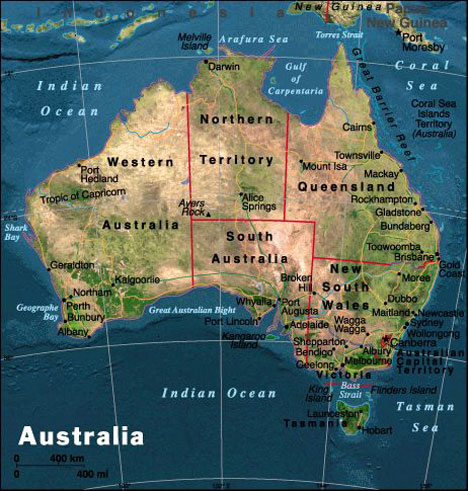
Australia, an island continent, is about the same size as mainland USA! So travelling from Sydney to Perth is about the same as going from Boston to San Francisco and Sydney to Cairns is about the same as Boston to Miami! So just keep in mind, you can’t visit all of Australia in couple weeks. Most people select part of Australia to visit during each trip!
About 80% of the Australian population resides within 20 miles from the Ocean! So the middle of the island, the outback, is pretty unpopulated and arid with some big cattle stations. The outback also offers Aboriginal culture and spectacular mountain ranges and escarpments. Aussie are some of the friendliest people and very open and engaging! It is a great experience spending some time with them. Also the Aboriginal Australians have been around for 50,000 years with their great rock art, storytelling, dance and music. You can learn how they survived in the desert interior of the island.
Australia has great natural wonders to offer – 600 national parks and 15 World Heritage-listed wonders. You can get close to its native wildlife, fauna and flora! We can send you to explore for the elusive platypus or the flightless
 
Cassowary! Would you like to cuddle a koala? Daintree Rainforest offers some unique native flora and fauna and some claim it to be older than the Amazon Rainforest!
You can find most any adventure you want in Australia. You can swim with sharks, play with dolphins, go surfing, try the various day and overnight hiking trails, go snorkeling or diving on the Great Barrier Reef or Ningaloo Reef, try your hand at opal mining, go sailing in the Whitsunday islands just to name a few.
If your idea of vacation is where action is, then we will send you to Australia’s vibrant and sophisticated cities. Each city offers some unique indoor and outdoor lifestyles, museums and art galleries, sports, dinning, nightlife and world class events. Attend an opera or a play at the world renowned Sydney Opera House, visit the Australian War Museum in Canberra or the National Gallery of Victoria to name a few!
Australia offers over 31,000 miles of coastline! You can learn how to surf at Bondie Beach! Relax on one of the many pristine, unspoiled, uncrowned beaches. Australians love their sandy playgrounds.
For the foodies, you can’t go wrong visiting Australia. The fine winemakers have produced award-winning wines and the creative chefs have shaped sun-kissed produce into a smorgasbord of cuisines. You can indulge in a variety of great cuisines and compliment your taste buds with top Australian wines.
Take a tour of what Australia has to offer in the following Walkabout Planner - sorry but you might need a magnifying glass to see part of it! Note that these are some driving routes but it will give you an idea what different parts of Australia has to offer.
Traveling in Australia
Aussies do speak English – you will be able to pick up the accent fairly quickly and they will help you – and so traveling is fairly easy no matter which mode of travelling you select. Parts of Australia are best seen driving – self-drive or we can organize a car with driver/guide or a small group tour – while you will need to fly from point to point for some other parts to make the most of your vacation time.
We have had a couple who picked-up a camper van in Darwin area and returned it in Sydney about six months later and they had a blast! In fact they returned to Australia couple years later to cover the parts they didn’t have an opportunity to visit!
For people short on time, we usually suggest flying from point to point and setting up base to explore that particular area. You can explore with day tours and so have some free time on your own to do any new things you discover.
We have travelled extensively throughout Australia and we will plan your itinerary based on our personal knowledge. We also have met the local tour operators and so know which ones will work best for you based on your likes and dislikes. We usually plan individual itineraries to meet your requirements and tastes. So to plan your vacation, we would discuss with you what your interest and requirements are and based on that we will plan a detail itinerary for you to review.
However, we do realize that not everyone wants to a custom tailored vacation package. Some of you like travelling with a group of people with an escort who will take care of some of the details and logistics for you! We do work with some tour operators providing escorted tours and based on your interests and needs we will match you up with the right tour operator.
Click here if you want more information on Escorted Tours.
Train travel is also very popular in Australia. Some of the iconic train rides, which are comparable to The Orient Express, are The Ghan from Adelaide to Darwin; The Indian Pacific from Sydney to Perth; The Southern Spirit from Brisbane to Adelaide via Sydney and Melbourne and The Sunlander from Brisbane to Cairns. Most of them offer three different travel modes – Platinum Service, Gold Service and Red service. Platinum service offers luxurious, spacious private cabins and elegant dining. Meet up with fellow travels in the lounge to swap stories.
Please follow the links below for some brief details about different States and Territories of Australia.
New South Wales
Queensland
Victoria
Tasmania
South Australia
Northern Territory
Western Australia
Canberra
Customize your trip
to Australia! Call Kash Patel, Premier Certified Aussie Specialist, who can custom tailor your dream vacation to Australia. Kash has travelled extensively throughout Australia and he can plan an itinerary (based on his personal knowledge) which will include your interests and desires.
Visa
Anyone
wanting to enter Australia must carry a valid passport or similar
certificate of identification and everyone, except holders of
Australian and New Zealand passports, requires a visa to enter
Australia.
The Australian visitor visa can be obtained from your nearest
Australian high commission, embassy or consulate. The Electronic
Travel Authority (ETA) is becoming progressively available through
travel agents.
Seasons
to Visit
Australia
is an all-year-round destination, but during the summer, December
to February, it is hot in Western Australia, Northern Territory
and Queensland. At the Great Barrier Reef, most rain falls in
January and February. In northern Queensland and parts of the
Northern Territory and Western Australia, roads may flood during
the "wet" season, January-March. The ski season occurs
from June to October in New South Wales, Victoria and Tasmania.
Climate
Spending
Christmas at the beach or skiing in August may seem strange but
the fact is, Australia's seasons are the opposite of the northern
hemisphere - summer starts in December, autumn in March, winter
in June and spring in September.
Due to its size, geographical location and the lack of extensive
high mountain ranges Australia has a wide range of climates but
generally no extremes. The average temperature ranges from 23-26
degrees Celsius above the Tropic of Capricorn with the southern
areas more temperate although subject to variations. This and
the fact that Australia is the driest continent on earth makes
our land a great all-year destination. In fact in our winter you
can ski in the southern states one day and be diving at the Great
Barrier Reef in Queensland the next.
Clothing
Check
the temperature chart and the weather maps carefully. In the tropics
lightweight clothing (natural fibres) is suitable all year round.
In the southern temperate regions, summers (December February)
are warm to hot and lightweight clothes are suitable for daytime,
but keep a jacket or sweater handy as nights may be cool. For
the southern winters (June-August), sweaters, a jacket or light
coat and generally warmer clothes are advisable. Australians are
informal dressers, but for special occasions, such as business
meetings, theatres and dining at good restaurants, men may need
a jacket and tie or suit and women a more formal dress. Most of
the time just keep clothing light and comfortable. Bring a sunhat,
sunglasses and suntan lotion if you expect hot weather. For foot
protection in the coral pools of the Great Barrier Reef, pack
your sandshoes (sneakers).
Language
English
is Australia's official language - though you will hear many colourful
local expressions as well as the Australian accent. Do not hesitate
to ask questions; people in Australia are very helpful.
Electricity
The
electrical current in Australia is 220-240 volts, AC 50Hz. The
Australian three pin power outlet is different from that in some
countries so you will need an adaptor. If your appliances are
110V, check if there is a 110/240V switch. If not, you will need
a voltage converter. Universal outlets for 240V or 110V shavers
are usually found in leading hotels.
Tipping
Tipping
is not the general custom in Australia and service charges are
not added to accounts by hotels and restaurants. Porters at airports,
taxi drivers and hairdressers do not expect to be tipped although
you may do so if you wish. Porters have set charges at railway
terminals, but not at hotels. In better-class restaurants, it
is usual to tip food and drink waiters up to 10 per cent of the
bill for good service. At any time, tipping is your choice.
Electronic
Banking/Automatic
Teller Machines
Banks
have ATMs (Automated Teller Machines) located outside the branch
or in the foyer, that can be accessed 24 hours a day. To access
an account, cardholders are required to use their Personal Identification
Number (PIN) when obtaining cash or services. Cards can be used
in Australia at both ATMs and at most retail locations, as long
as they have been enabled for international access. Please contact
your bank for information on availability and service charges.
Credit
Cards
The
most commonly accepted credit cards are American Express, Bankcard,
Diners Club, MasterCard, Visa, JCB and their affiliates. Use may
be restricted in smaller towns and country areas and small retail
shops.
Sun
Protection
Enjoy
outdoor activities such as sightseeing, bushwalking, boating and
camping without the risk of harmful exposure to the sun by using
simple skin protection. Wear a broad-brimmed hat, a shirt with
a collar and sleeves, and pH 15+ broad-spectrum, water-resistant
sunscreen on exposed areas of skin. Try to avoid the sun during
the middle of the day, between 10am and 2pm (11am and 3pm in daylight
saving time) when the ultraviolet rays are at their strongest.
|